
Minimal Audio On Building Plugins Customers Can Trust

Minimal Audio founder Jake Penn (picutred above) has helped develop the company around an approach that combines original DSP research, direct customer relationships, and a catalog designed to improve as new technology becomes available. Its commercial model gives producers the choice between perpetual licenses and All Access, while direct sales remain the company’s primary revenue source.
Lucid represents the latest extension of that approach. The granular effects plugin assigns pitch detection, pitch shifting, and an effects chain to individual grains, allowing incoming audio to follow a selected scale without sacrificing DAW synchronization. Much of the engine was developed specifically for Lucid, including its grain engine, low-latency pitch shifter, and timeline-locked stretching and scrubbing technology.
Ahead of WMC, we spoke with Penn about the technical work behind real-time grain scale-locking, deciding which processing belongs inside each grain, distributing software through several sales channels, and maintaining customer trust while offering perpetual licenses and subscription access and you can be apart of converstaions like this by purchasing your 2027 WMC badge here.
Interview With Jake Penn

Granular effects often produce unpredictable pitch relationships. What technical problem did Minimal Audio need to solve before real-time grain scale-locking became commercially viable?
Hey Will, thanks for chatting with me.
The hardest part of Lucid was scale-locking every single grain in real time without the CPU usage or latency blowing up. Most granular effects change pitch by speeding playback up or down. That’s inexpensive computationally, but every grain lands wherever the math puts it, which is where those unpredictable pitch relationships come from.
In Lucid, every grain gets its own pitch detector and pitch shifter. To make that viable, Damien on our DSP team built a new low-latency pitch shifter that was light enough to run per grain. We combined it with our scale-snap and retuning technology, then latency-compensated every grain so it stays synchronized and locked to your DAW’s tempo.
We also had to make it simple. Early builds had many additional controls, and we reduced them to three modes. After launch, the biggest request was lower latency, so we shipped an even lower-latency mode in version 1.1 within a few weeks.
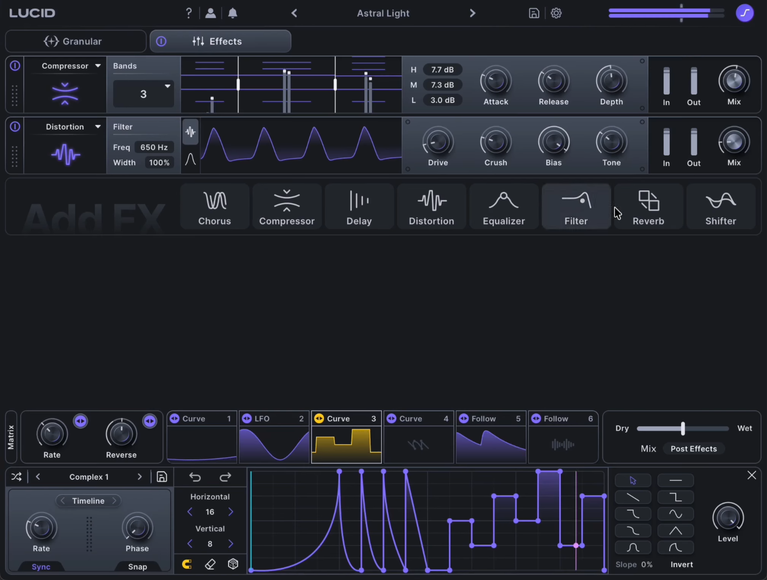
Lucid applies filtering, drive, stereo imaging, and modulation at the grain level. How much processing occurs per grain, and which operations are shared across the complete output?
There’s a full effects chain inside every grain. That’s what makes the scale-locking possible, and it’s also where some of the most interesting timbral results come from.
Our rule for what runs per grain was simple: if an effect didn’t sound meaningfully different per grain than it did on the summed output, it belonged on the output. The processes that earned their place, and became our favorites, are the grain filter, stereo imager, and delay, alongside the pitch shifting.

How much of Lucid’s engine uses technology developed for earlier Minimal Audio products, and which components were written specifically for this release?
Most of what defines Lucid was built for this release. The grain engine was written from scratch, along with a pitch shifter, the per-grain effects chain, and the DAW-synced stretching and scrubbing that keep everything locked to your timeline. That’s how we approach every product: the core engine is always new, with fresh research behind it.
The development also works in reverse. What we build for a new product feeds back into the older ones, so the complete product line keeps improving with each release. The low-latency mode we built for Lucid is going into Evoke now. Around that core, we share technology where appropriate, including the scale-snap and retuning system from Evoke, plus the modulation system and insert effects rack that accompany the main engine.
What role do direct sales, third-party retailers, affiliate partners, and educational content play in Minimal Audio’s software distribution model?
For us, direct sales are the core. Most of our revenue comes from returning customers through our own store, through perpetual licenses and All Access, and that’s where we can support people most directly.
Retailers such as Plugin Boutique and Splice introduce us to many producers who might never have found us otherwise, while press outlets and creators are also a major part of how people discover us.
Education is important, although it is difficult to measure. A plugin like Lucid really clicks when you see someone use it, so we put a lot into walkthroughs, tutorials, and the manual.
As music software companies compete across perpetual licenses, subscriptions, and product ecosystems, which commercial model do you believe gives independent developers the best chance of funding long-term development without weakening customer trust?
I think everyone should be able to access their tools however they prefer. There’s a lot of value in having a large toolkit for a small monthly price, but I also understand wanting to own everything you use outright.
We therefore offer two options: buy any plugin outright or get everything through All Access, which I think strikes the right balance. It’s a far better offering than rent-to-own while providing the same benefits and additional access.
Beyond the model, trust comes from how you operate it: loyalty pricing, shipping updates and products, customer support, and a good post-purchase account and installation experience.
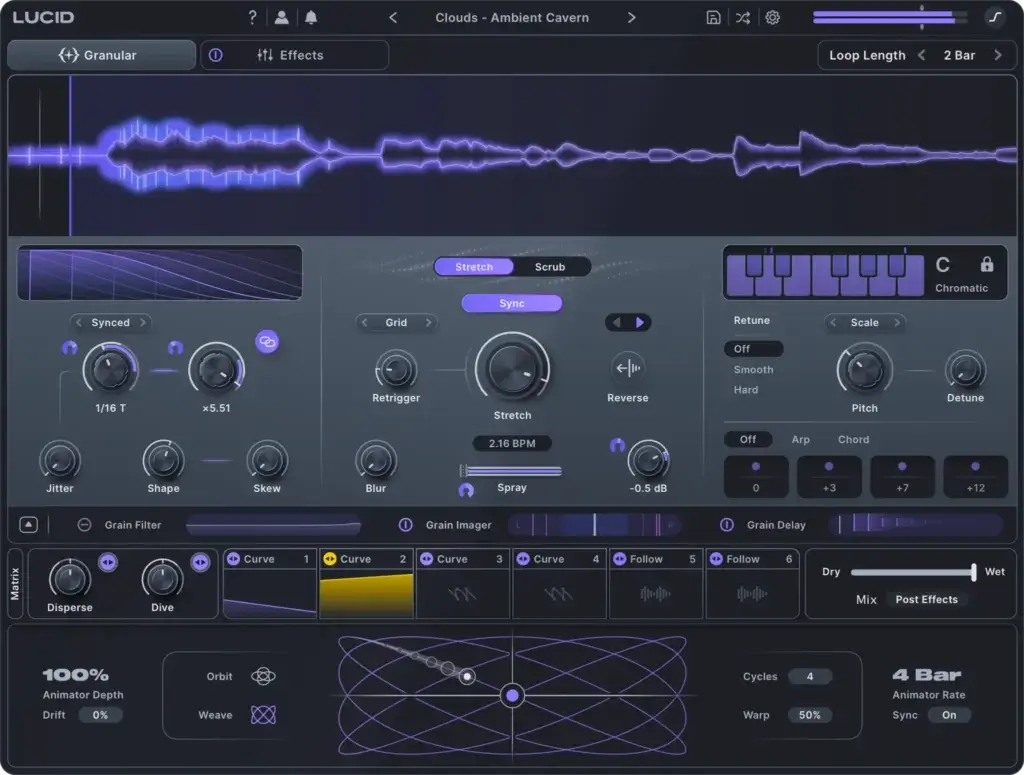
Has the launch of Lucid taught you anything new about the plugin market and selling music production software in 2026 that you did not know before the launch and rollout?
The biggest lesson for me was the shift away from launch materials toward deeper, technical content. For Lucid, the in-depth walkthrough continued gaining views in the weeks after launch, faster than any of our other videos. People want to understand a tool before they commit to it.
I think we got that right. We put a lot more into the resources surrounding Lucid this time, including a better manual, the Hub, and the website, and it paid off. It’s our biggest launch yet, and hearing from artists we look up to has been incredible.